EXPOSED: Inside curling's decade of shame (points, spam folders, beer and the boop)
A satirical investigative report on the politest sport on ice: a field guide for newcomers, Madison's points system, the club mailing list that ended up in everyone's spam folder, the honour bar, the sweeping wars, the Madison–Seattle schism, and Boopgate.
JT (Jess)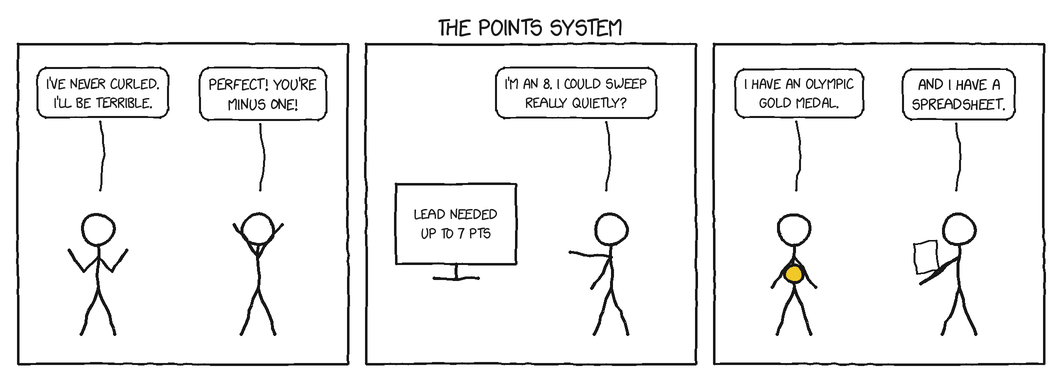
November 2026. A special investigative report by zjt, built from one club curler's notes (JT's), a mailing list JT used to moderate, and far too much free time. Every fact below is real and links to its source at the end, or comes from club email and JT's own memory. The outrage is artisanal, locally sourced, and zjt's.
Folks, I have to tell you about a sport. A sport so wholesome it makes golf look like a prison yard. A sport where nobody referees, because the players call their own fouls. Out loud. Before anyone asks. Where the losing team shakes hands first. Where cheering your opponent's miss is considered roughly as polite as setting their car on fire.
That sport is curling, and tonight we pull back the polyester curtain. Not on the Olympics, although we'll get there. On the place the real rot lives: the curling club. Specifically, its points system, its honour bar, its roof, and its mailing list, which I moderated for years and which I can now confirm is where curling's soul goes to get marked as spam.
Housekeeping: Madison curlers have a sincere iconography, and it is the pheasant. Sweaters, clocks, mugs, wall art. Five pheasants are hidden in this post's drawings. There is no prize. There is never a prize.
Curling for people who have never curled
Before the scandals, the field. If you've only seen curling for ten minutes every four years, here's what you were looking at.
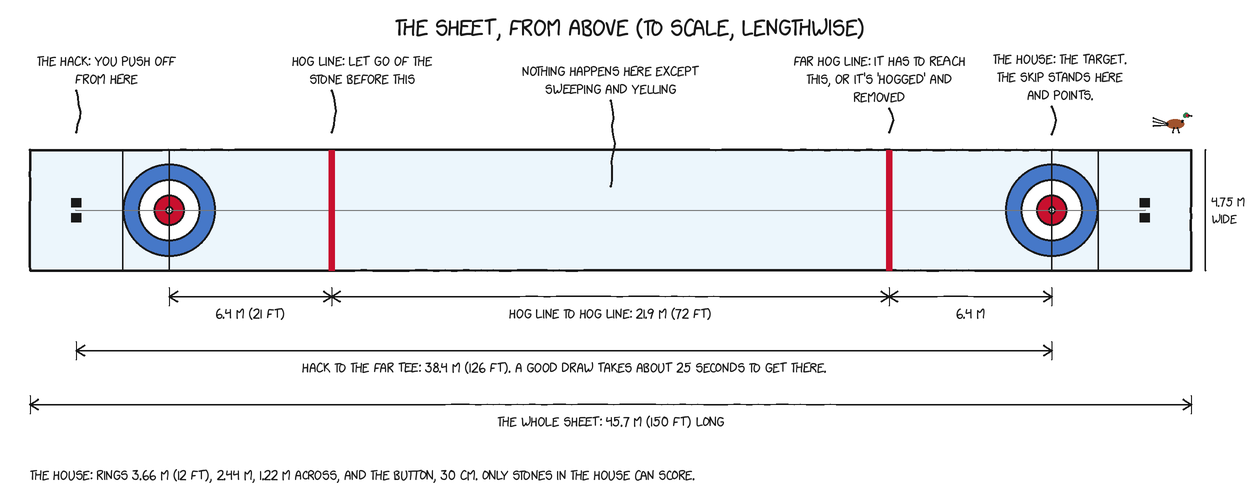
A sheet of ice is about 45 metres long and under 5 metres wide: picture a bowling lane the length of a hockey rink. You push off from the hack, slide out, and must let go of the stone before the first hog line. The stone then has to make it past the far hog line, about 22 metres later, or it's "hogged" and taken out of play. The target is the house, a set of rings 3.66 metres across. A good draw takes about 25 seconds to get there, and the entire time, people are screaming.
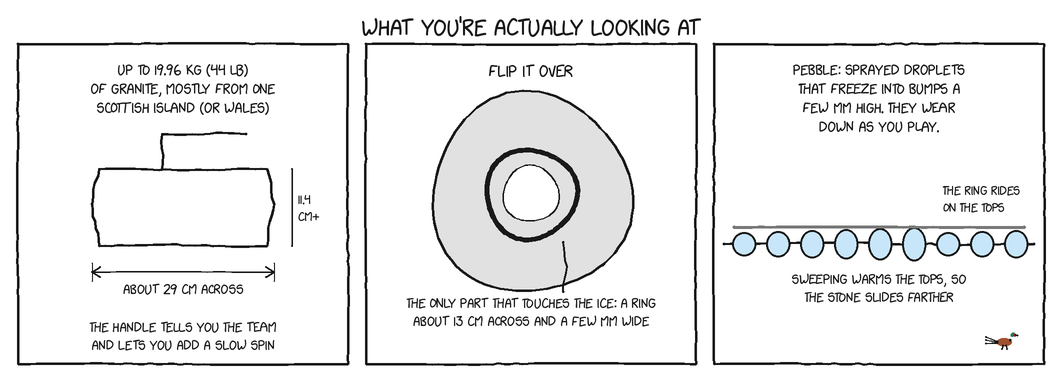
The stone is up to 19.96 kg (44 lb) of granite, almost all of it from one Scottish island or a quarry in Wales. It touches the ice only on a thin ring underneath, the running band, about 13 cm across. And the ice isn't flat: it's sprayed with water droplets, called pebble, that freeze into tiny bumps. The stone rides on the tops. Remember the pebble. It will matter later, in Seattle.
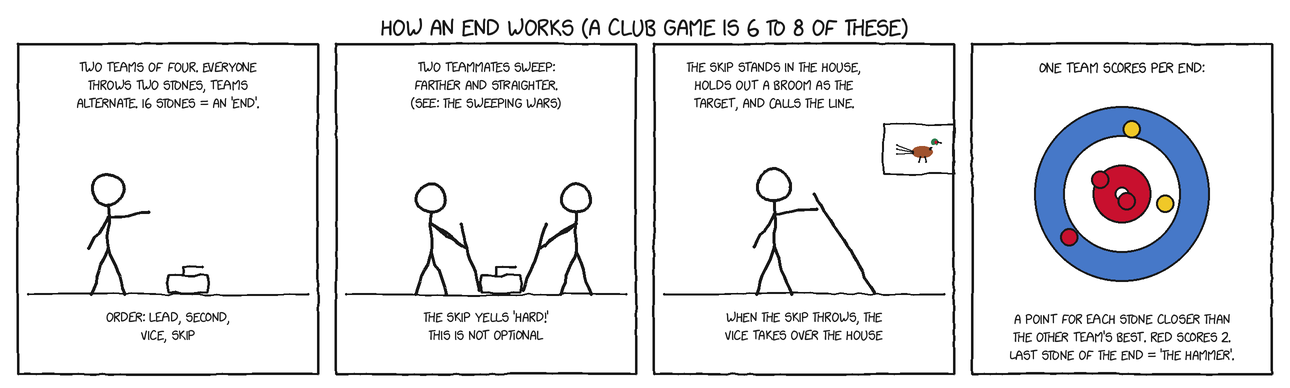
Each team has four players, and each throws two stones, alternating with the other team. Sixteen stones make an end; a club game is six to eight ends. The skip stands in the house, holds out a broom as a target and calls the shot, and when the skip throws, the vice takes over. After the last stone (the hammer), only one team scores: one point for each of its stones closer to the centre than the other team's best. That's it. That's the whole sport. Everything else is etiquette, physics folklore and email.
Part one: The points system (Madison)
Every sport has a way of keeping the good players from steamrolling the beginners. Golf has handicaps. Bowling has handicaps. The Madison Curling Club has points, and I have never encountered anything like it at another club.
Here's how it works. Every member carries a number that rises with experience and competitive play. Almost every league caps the team total: the big men's and women's leagues sit in the 40s (one is 45 per team), and a few low-point leagues exist precisely so that the people who skip in other leagues can't play in them, which gives everyone else a chance to try skipping without being flattened. One league on Monday has no cap at all, so a team there can carry, as one Madison podcast host put it, "theoretically a max of 80."
And then there is my favourite rule in all of sport. The club's intraclub men's bonspiel caps each team at 32 points, and members may bring a friend who has never curled. That friend counts as minus one. Read that again. In this sport, being bad is a resource. Bring someone who's never touched a stone and your team gets better on paper. It's the only recruiting pitch in the world that goes "Don't worry, you're terrible, that's why we want you." (In 2025 the organizers proposed opening the spiel to all genders, on the grounds that everyone deserves one weekend as a −1. The board ran a survey. Of course the board ran a survey.)
Personal disclosure, in the interest of journalistic integrity: in February 2024 I brought a −1 out to throw a few practice rocks before our game on sheet 4. The −1 was a −1. The ice paid for it. I emailed the ice maker an apology that evening, which is, I believe, the only time anyone has formally apologized to ice.
Where it gets controversial
Here's the problem. Wisconsin is not a normal place. The Madison club has produced Olympians, and Olympians don't retire from curling; they just go back to league night. One of the club's own Olympic gold medallists curls in the regular leagues, and one bonspiel offered members the once-in-a-lifetime chance to hit him in the face with a pie. Plenty of elite curlers play club leagues around the country (Seattle's Granite club claims more national championship teams than any other club in the US). But those clubs just let the good players be good. Madison gives them a number, and then every team has to fit that number under a cap.
So the arguments write themselves. Is a gold medal worth the same as twenty-five years of Tuesday nights? Should a national champion who now curls once a week still count like one? If your team is two points over, who has to go? These are not hypothetical questions. These are emails.
The playoffs get stricter still. In the men's league playoffs, a sub can't have more points than the player they're replacing, can't play a different position, and can't play below their usual position. And if you show up with only three players, a rule (12 G, if you're keeping score) recalculates whether you're now overpointed, "after adjusting points for the remaining players and the number of stones they throw." Curling: the only sport where being short-handed can make you too good.
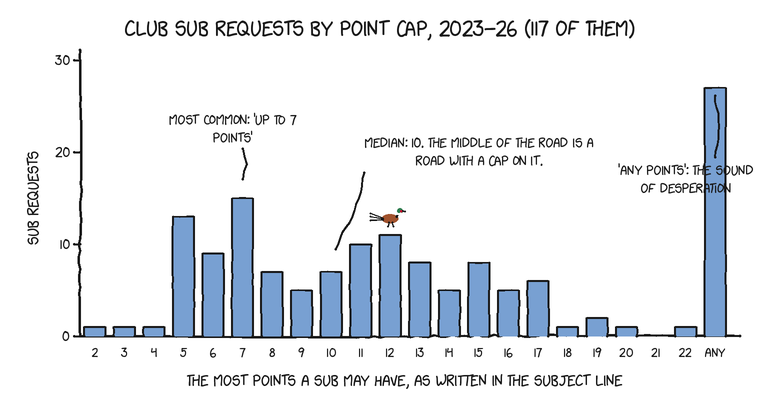
But the real place you see the points system is the subject lines. Every sub request on the club list announces its cap, like a nightclub bouncer with a clipboard: "Lead needed tonight, up to 7 points." "Skip, up to 16 points." "VICE SUB up to 14 points." I counted them.
Show the math: what the subject lines say about the points
I went through every sub request on the club list from November 2023 to November 2026, about 650 original messages, and pulled out the ones that state a cap in the subject line.
117 requests name a number   median cap: 10   most common: 7 (15 times), then 5 (13 times)
 27 say "any points" or "no point limit"
lowest cap: 2       highest: 22
A team cap in the 40s, split over four people, is about 11 points each, so a median sub cap of 10 is roughly "an average player for this league". The pile-up at 5 to 7 is the low-point and newer-curler leagues. The "any points" bar is the sound of a skip at 4:15 for a 4:25 game.
The −1 never shows up in a subject line. Nobody has ever written "Sub needed, must be terrible." Yet.
Part two: Clubnews, the inbox that ate a curling club
I was the moderator of the Madison club's mailing list, Clubnews. I am also, professionally, an email nerd. I have opinions about DMARC. I have sent drafts to the IETF. So please understand that what follows is not satire so much as a support ticket.
Clubnews is where the club talks to itself: league sign-ups, bonspiels, the kitchen, the roof, lost brooms. And, overwhelmingly, sub requests. In the 2024–25 season the list carried 957 emails, and 55% of them were about subs: requests, second requests, "PLEASE???" requests, replies, and the triumphant two-word follow-up, "Sub found!"
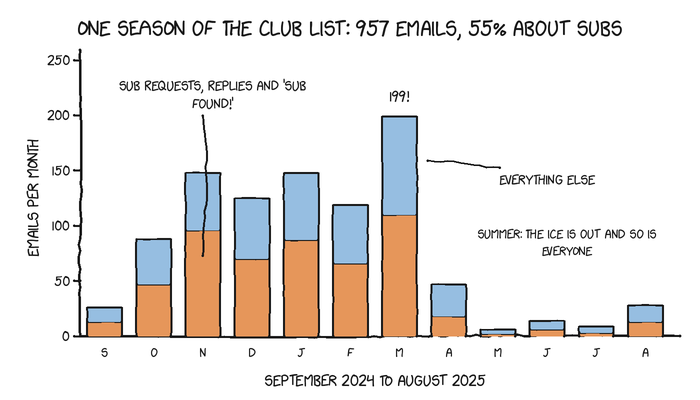
Now imagine you joined a curling club to throw rocks once a week, and your inbox gets 199 emails from it in March. Some members did what people do. They clicked Report spam. And the spam filter, being a machine-learning system with no context and infinite confidence, learned the lesson: the curling club is spam. All of it. Including the email about steak night.
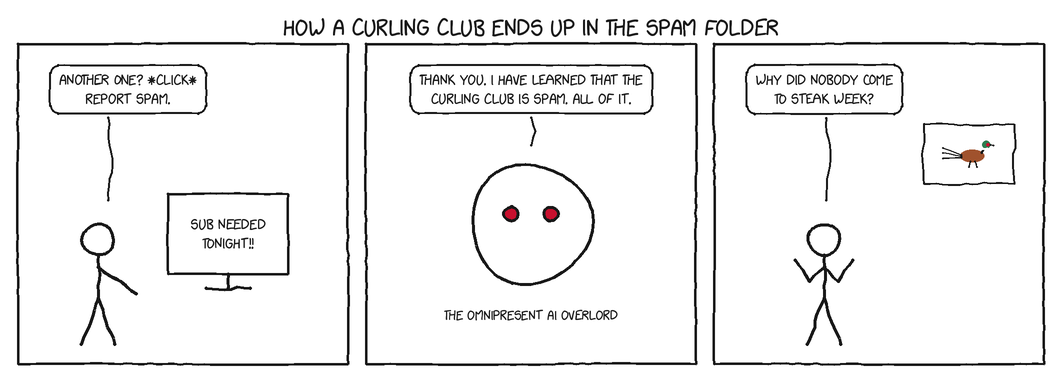
So the list administrators (hi) added a footer to every message, which I will now quote in full because I'm proud of it:
> Please look in your spam folders for any Clubnews messages and "report not spam" if your email provider supports it. Many people have been reporting Clubnews messages as spam, resulting in our omnipresent AI overlord to learn and bend our society to its will. Sub requests can be annoying, but they are good for members looking to gain more experience curling with other teams. If you do not want to see them, ask a fried how to create a email filter.
Yes, "ask a fried". It stayed that way for over a year, on every message, and not one person reported it, which tells you exactly how many people read footers.
Then the escalation, in the time-honoured club style:
- November 2024. The Games Committee asked everyone to stop sending sub requests to the whole club first. Every league page already had a list of people who'd volunteered to sub. The website committee then added a button that collects all their addresses at once. Clubnews, they said, should be "your last resort."
- The sub requests continued. See chart.
- January 2026. The Facilities Committee announced that, because of members missing club news and messages landing in spam, Clubnews was moving off Google Groups to a new group on the club's own domain. Everyone would be migrated; the old address would forward for a few weeks. At least one member responded by replying to the entire club with two words: "Not spam."
There are also two Jesses on the list, so I signed my own sub requests "JT (not JP)". That's the email equivalent of writing your name on your lunch in the office fridge. It didn't always work.
Show the math: why a mailing list goes to spam (for email nerds)
Two separate problems, and only one of them is the members' fault.
1. Complaints. Since 2024 Gmail and Yahoo tell bulk senders to keep the spam-complaint rate under 0.3% (and ideally under 0.1%). A complaint rate is just clicks divided by deliveries:
complaint rate = "report spam" clicks ÷ messages delivered
one message to 500 members, 1 click:  1 ÷ 500 = 0.2%   fine
same message, 2 clicks:               2 ÷ 500 = 0.4%   over the line
On a list of a few hundred people, the difference between "fine" and "spam folder for everyone" is one more annoyed curler. A sub request is the most clickable email in existence: it isn't for you, it's urgent, and there will be another one in an hour. (500 is a round number for illustration, not the club's actual membership.)
2. DMARC. About 13% of the messages in my copy of the list (262 of 1,981) arrived with the sender shown as 'Somebody' via Madison Curling Club. That's the list protecting itself. When someone posts from a provider whose DMARC policy says "reject anything that doesn't authenticate", like Yahoo or AOL, the list can't deliver it as-is: the [Clubnews] subject tag and the footer break the sender's DKIM signature, and the list's servers aren't the sender's servers, so SPF fails too. So the list rewrites the From line to its own address. It works, it confuses everyone, and it's the reason a curling club's emails say "via". ARC was supposed to fix this. Email nerds are still discussing it, at length, on mailing lists, some of which go to spam.
Moving to the club's own domain doesn't change DMARC, but it gives the list its own sender reputation instead of sharing one with every other Google Group on earth. It also resets the complaint history. Please don't click spam.
Meanwhile, Thursday late carries on without me. Nate skips my old team now that I've gone west, Stinker Steve still plays by the anti-rules, and Jake, the other moderator in my life, would like this taken to #thursday-late.
Part three: The honour bar, the kitchen, the roof and the expansion plan
The Madison Curling Club in McFarland, Wisconsin has curled since 1921, when it started on one sheet under the Camp Randall stadium bleachers. A century of tradition. And a century of tradition produces a lot of email.
- The beer taps. For as long as anyone can remember, the beer was on tap on the honour system: members poured their own and paid their own way. At bonspiels it was closer to a free-for-all. Ah, the honour system, curling's one big idea, applied to draft beer. What could possibly go wrong? First came locking cabinets for the taps. Then, last winter, the village police ran an alcohol sting. At the curling club. Picture the briefing: "Johnson, you're going undercover. Your cover is: guy who wants to throw rocks at a target on a Tuesday." And a club whose bar has no bartender suddenly looked like a problem. Now the tap doors are locked every night, strangers who ask to pour a beer get asked whether they're a member, and the outside door may stay locked around the clock. The honour system: undefeated against foreign brooms, undone by a local cop.
- The kitchen. It's a commercially licensed kitchen with a yearly county health inspection, and one season the inspector delivered the news that cooking steak sous vide requires its own special license. Somewhere in Dane County there is a form for warm bags of meat in a water bath. Steak week refused to retreat to "the old grill and serve way" and soldiered on while a volunteer worked through the paperwork. That's not a kitchen. That's a resistance movement. (Every winter break there's still a reminder to label, store or throw out everything in the fridge, because the inspector does not take holidays.)
- The roof. One winter, snow piled up until water started dripping toward the ice shed. Members spent a day on the roof shoveling, the next email was titled "Roof Rules", and some months later another one arrived, with photographs, explaining why you walk on the flat part of the metal panels and not on the ribs: step on a rib and the metal crimps, cracks, and gets caulked, and caulk is not forever. The first reply asked who had been on the roof. Somebody walked on the ribs. We know who you are. Well, the roof does.
- The expansion plan. In spring 2020 an expansion committee was ready with a club-wide survey, designed with the help of a professional surveyor, about members' experience and whether the club should grow. Launch date: May 2020. May 2020. "Would you like more curling sheets?" asked the survey, to a membership that was at that moment disinfecting its groceries. The results were presented at the club's first online-only annual meeting, on the same evening as the pandemic plan. I'll let you guess which agenda item got the follow-up questions.
Part four: The sweeping wars (everyone is a physicist)
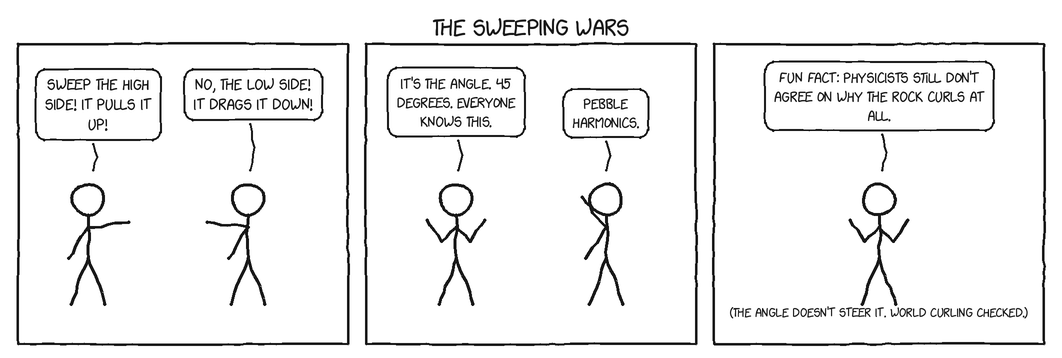
Walk into any club on any league night and you will hear it. "Sweep the high side, it pulls it up!" "No, the low side!" "It's all in the angle!" "Don't sweep on top of it, clean in front!" Every curler I know has a theory. Every theory is delivered with the confidence of a man who has had exactly two beers. And as far as anyone can measure, almost none of them do what their owners think.
(A word from the Vice, a fictional meteorologist and former vice skip of a Madison team, who gives an annual talk on the Edmund Fitzgerald: "On a sailboat, the wind decides. On a curling sheet, the wind is irrelevant, which is why curling is the superior water sport." He has never been invited to explain sweeping. He has explained it anyway.)
Exhibit A. In 2016, after a broom scandal we'll get to, World Curling had elite athletes try "every imaginable technique and angle" with legal brooms, to see whether they could change how the rock behaved in any significant way. They could not. The direction of the brush stroke, side to side or straight up and back, had "little if any out-of-the-ordinary impact". World Curling then decided it didn't need technique rules at all, beyond two: don't leave debris in the stone's path, and finish your last stroke off to the side. (Not everyone in the broom business agrees: on Curling Nation, a broom designer said a firmer foam is exactly what lets you sweep a stone directionally. The argument continues, as arguments in this sport do, until someone has to throw.)
Exhibit B. Nobody agrees why a curling stone curls in the first place. I don't mean the club. I mean the physicists. There's the old asymmetric friction idea (the front and back of a spinning stone grip differently), the Swedish scratch-guide theory (the front edge scratches the ice and the back edge follows the scratches; they steered stones by carving fake scratches), and the Canadian pivot-slide theory (the stone catches on pebbles and pivots, over and over). A 2022 overview was titled, and I'm quoting, "we still don't know how it works".
Exhibit C. When the steering brooms of 2015 reached club ice, the theories got personal. On Curling Nation, John Cullen, who made a whole podcast about Broomgate, said players with the new brooms were hearing that "their Wednesday night mixed league people were calling them a cheater", and that "some of the drama at the club level was… a little bit ridiculous." One of the hosts tried the black heads in a league game: a couple of sweeps "carved" a wide stone onto a perfect tick, and the very next stone went so differently that it "was enough to make us think well maybe we don't know what we're doing." Ten years on, Cullen's verdict: "most people now would never say that anybody was cheating."
And the theory your teammate explained to you over a beer, the spin one? It has a problem. A stone only turns a couple of times on the way down, and spinning it harder does not make it curl more. Spin it too hard and it barely curls at all.
So the next time someone at your club explains the exact wrist angle that "pulls" the rock, nod respectfully. They are wrong in excellent company.
Show the math: what sweeping actually buys you
A curling stone is about 20 kg of granite riding on its running band, and ice friction slows it at a nearly constant rate. Call the friction coefficient μ. The stone loses speed at a = μg, and from speed v it slides
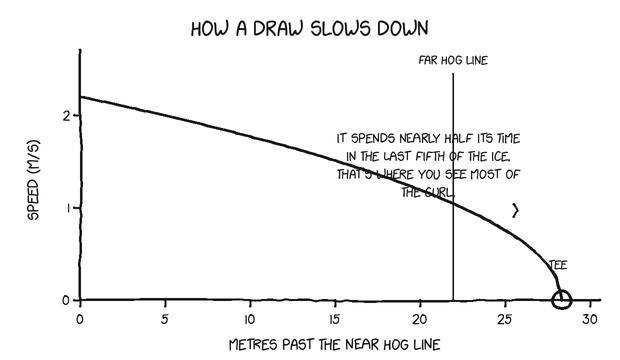
d = v² / (2 μ g)Curlers time a draw from hog line to hog line (21.95 m). A typical 13.5-second draw that stops on the tee, 28.35 m past the near hog line, works out to:
μ ≈ 0.0087 a ≈ 0.086 m/s² speed at the near hog line ≈ 2.2 m/s whole slide ≈ 26 sThat μ sits inside the 0.006–0.016 measured on the Beijing Olympic ice. (Real friction also drops a little as the stone speeds up. Ignoring that is what physicists call "an approximation" and curlers call "the ice is weird tonight".)
Sweeping warms the ice just ahead of the stone, which lowers μ there. Think of it as a budget: the stone starts with ½v² of energy per kilogram, and every metre of ice costs μg. Sweep a stretch of length L and cut the friction there by a fraction f, and you save f × μg × L, which buys about
extra distance ≈ f × L / (1 − f)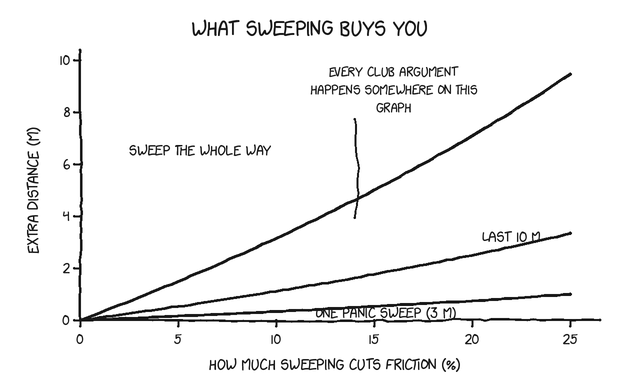
Two things fall out of that:
- Cutting friction by 10% for the whole trip is worth about 3 m. For the last 10 m, about 1.1 m. One panicked 3-metre burst, about 30 cm.
- The 2025 foam fight in these terms: an extra 0.9–1.8 m (three to six feet) over a 28 m draw means the foam cut friction by only about 3–6% more than a normal broom. Small to the ice, enormous to the scoreboard.
- In this simple model, a metre swept early buys the same distance as a metre swept late. Real ice is messier (warmed ice cools off before the stone arrives, and friction depends a little on speed), which is why "sweep it now or it's too late!" and "save it for the end!" are both only half right.
Show the math: why "just spin it more" doesn't explain the curl
A draw turns about 3 times in about 26 seconds. The running band is roughly 13 cm across, so its edge moves sideways around the stone at
2π × 0.065 m × 3 turns ÷ 26 s ≈ 0.05 m/scompared with the stone's forward speed of up to 2.2 m/s. Spin changes how fast each side of the band moves over the ice by a couple of percent at most. Yet the stone ends up curling a metre or more. That's the puzzle: a tiny asymmetry has to produce a huge effect, which is why physicists keep proposing new mechanisms (scratches, pivots) instead of settling on friction alone.
The one thing every theory and every curler agrees on: stones curl most when they're slow, near the end of the trip, which is also where the speed chart above shows them spending nearly half their time. Sweeping keeps the stone faster for longer, so a swept stone goes farther and straighter. Which side you sweep on, at what angle, while chanting what: by World Curling's own testing, not much.
Part five: The Madison–Seattle schism
I've curled at two clubs: Madison from 2009 until March 2026, and Granite Curling Club in Seattle since April 2026. Granite opened its building in 1961 and claims more US national championship teams than any club in the country. Having curled in both places, I can report that the two clubs agree on the rules of curling and on almost nothing else. In my completely unbiased, Wisconsin-trained opinion:
- Handshakes. In Madison you shake hands with the other team and your own team, because we are a warm people. In Seattle you shake hands with the other team only. Your own teammates get a nod. It's very Pacific Northwest: polite, sincere, and two metres away.
- Cleaning the ice. In Madison you sweep the debris off the sheet and then vacuum your brush. In Seattle you sweep the dirt back onto the ice, and then sweep it up again. I have watched this many times and I still can't tell you which half of the process is the cleaning.
- Cleaning the stones. In my experience, almost nobody in Seattle knows how to clean a rock. In Madison this is taught roughly alongside walking.
- Pebbling. Remember the pebble, the frozen droplets the stone rides on? They wear down as you play. In Madison, members were expected to pebble before a game, even after a modest practice, and the ice crew offers pebbling lessons before the morning scrape. In Seattle, regular members are not trusted with the pebble can, so the ice gets pebbled between games much less often. I'll say only this: one of these clubs asks its members to put water on the ice, and the other asks them to put the dirt back.
Granite Curling Club: the night a car tried out
Granite's most famous incident predates me, but the club wrote it up beautifully. At about 2:30 a.m. on Presidents' Day 2016, an out-of-control car hit the northwest corner of the building, broke a structural column, tore out a door and about 15 feet of fence, and set off the fire alarm. The passenger had minor injuries. The driver, and this is the only person in this entire report who did not shake hands afterwards, ran off.
Volunteers had a temporary wall up that day. The club lost one day of curling. Sheet 1 stayed closed for the rest of the regular season. And the club's official write-up floated the idea of mounting the license plate and grille from the debris on the wall, like a hunting trophy. That's the spirit. That's curling. Somebody drives a car into your building at 2:30 in the morning, and by sunrise you've rebuilt the wall and started planning the décor.
Part six: Meanwhile, in the big leagues
Fine. You came for the Olympics. Here is a decade of elite curling's shame, at the speed of a skip yelling "HARD!":
- Big Broom (2015–16). Broom heads with directional fabric let sweepers steer a stone, not just carry it, and for a season the sport had no rules about it. Twenty-two top teams signed a pledge not to use them (a pinky-swear, essentially), World Curling banned the fabric mid-season, and in 2016 a "Sweeping Summit" tested brooms with Canada's National Research Council. A government science lab. Testing brooms. Somewhere a particle physicist was told, "Sorry, the collider's booked, it's broom week." Later research found the banned heads scratched the ice several times deeper than legal ones. The legal broom polishes the road; the illegal one paved a lane.
- Big Broom: The Sequel (2025). Ten years later the scandal moved inside the broom head. World Curling and the maker suspended the Pursuer foam because on-ice tests showed it performed beyond the limits, even though it met the written specifications. It followed every rule and was banned for being too good at following them. A month before the ban, 2018 Olympic champion Tyler George told Curling Nation that top men's teams found some foams could "carry a rock an extra three to six feet", that "nobody was doing anything illegal", and that at one event the players had "all agreed to not use certain products" before anyone made them. The honour system, once again, doing the governing body's job. "It's always an arms race."
- Karma (PyeongChang, 2018). A Danish sweeper burned (touched) a moving stone; under the rules, Canada's skip got to choose the remedy and had it removed, which was legal and also the curling equivalent of taking the last dinner roll. The Danish skip said she was "pretty sure karma will hit you at one point." Denmark won in an extra end.
- Endurance doping (PyeongChang, 2018). A mixed doubles bronze medallist tested positive for meldonium, a drug that boosts endurance. For curling. A sport that pauses for snacks. He called denying it "stupid", lost the medal, and got a four-year ban.
- Last call (Red Deer, 2018). A team featuring a former Olympic champion was cut off by bar staff before a game, at a curling club, where the bar has its own sheet number. Organizers said he broke three brooms. The tour fined him $1,000, donated to junior curling, so in a sense the children won.
Part seven: Boopgate (Milano Cortina, 2026)
And now, the big one. The scandal that made non-curlers learn the phrase "hog line" against their will.
The rule: once you let go of the stone, you don't touch it again. Simple. Kindergarten simple. Hands off the granite.
At the 2026 Winter Olympics, during a men's round-robin game between Canada and Sweden on 13 February, Sweden's Oskar Eriksson accused Canada's Marc Kennedy of touching a stone again after release. Kennedy responded with a profanity-laden outburst that went viral, which is a sentence I never expected to write about curling. Swedish TV, which had helpfully moved a camera to the hog line, aired footage that appeared to show the touch. The internet named it "Boopgate", because of course it did.
World Curling's response? A verbal warning, because World Curling does not use video review. In 2026. Every phone in the building can film in 4K, and the official policy is basically "we'll take your word for it, pal." It then clarified that touching the granite during forward motion isn't allowed, which was already the rule. The rule now has a rule. And the ending was the most curling ending possible: everybody shook hands, nobody cheered a miss, and Canada went on to win gold. Probably nobody cheered a miss.
So did the boop actually matter?
Here is where I put down the outrage and pick up a calculator.
Distance goes as speed squared, so a small change in speed at the hog line turns into about twice that fraction in distance. For a draw, every extra 1 cm/s at the hog line buys about 26 cm. And a 20-kg stone gains 1 cm/s from a push of just 0.2 newton-seconds.
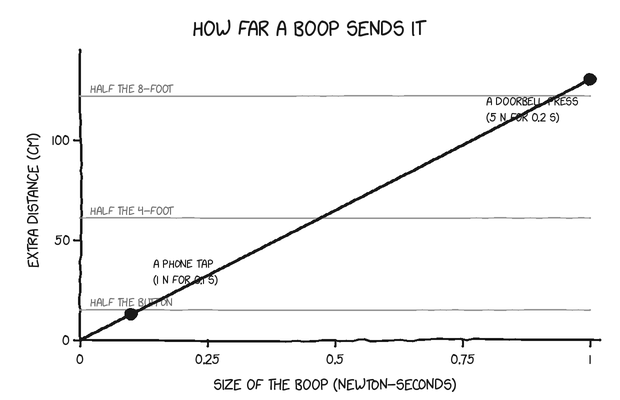
Translation: a fingertip push about as firm as tapping a phone screen, for a tenth of a second, adds roughly 13 cm, about the radius of the button (the 30-cm bullseye in the sheet diagram). Push a bit longer, or a bit harder, and you're moving the stone between rings.
The verdict:
- Can a boop matter? Absolutely. Curling is a game of centimetres, and a boop is a cheap way to buy a lot of them. That's why the rule exists.
- Did that boop matter? Nobody can know, me included. A touch only changes anything if it pushes (or drags): a hand moving at exactly the stone's speed transfers almost nothing. Footage can show a finger on granite; it can't show newtons.
- Could you steer with it? Not really. A fingertip on the side adds a little spin, and as the sweeping wars taught us, more spin doesn't mean more curl. The danger of a boop is speed, not steering.
Even the experts can't agree. On the podcast Curling Nation, three Madison curlers spent several minutes on Boopgate. They called it "an unknowing rules infraction", decided he was probably "just dragging his finger across it" (which, per the math below, would cost him distance, not gain it), compared it to a golf ball rolling half a ball before you swing ("you gained no advantage… but technically it was a rules infraction"), and then could not agree among themselves whether you're even allowed to touch the stone before the hog line. The rule, they concluded, is "pretty ambiguous." Curling, ladies and gentlemen.
Show the math: the boop
From d = v² / (2a), a small change in speed Δv changes the distance by
Δd ≈ 2 × d × Δv / v = 2 × 28.35 m × Δv / 2.20 m/s ≈ 26 cm for every 1 cm/sA push F held for a time t is an impulse J = F × t, and it changes the speed of a 19.96 kg stone by Δv = J / m:
| Push | Impulse | Speed change | Extra distance |
|---|---|---|---|
| 0.5 N for 0.1 s | 0.05 N·s | 0.25 cm/s | about 6 cm |
| 1 N for 0.1 s (a phone tap) | 0.1 N·s | 0.5 cm/s | about 13 cm |
| 2 N for 0.1 s | 0.2 N·s | 1 cm/s | about 26 cm |
| 1 N for 0.3 s | 0.3 N·s | 1.5 cm/s | about 39 cm |
| 5 N for 0.2 s (a doorbell press) | 1 N·s | 5 cm/s | about 1.3 m |
For scale: the button is 30 cm across, the 4-foot ring 1.22 m, the whole house 3.66 m. It also works in reverse: drag a finger along it and you take the same distance off. (Finger forces are rough everyday figures, not measurements of anyone's actual finger.)
Conclusion: the system is working (the system is a pinky-swear)
So what have we learned from our investigation?
- The points system is the most honest thing in curling: everyone has a number, everyone knows everyone's number, and the arguments are public, in the subject line, at 4:15 p.m.
- Mailing lists are where curling's honour system meets the spam filter, and the spam filter wins. Please don't click spam. Make a filter. Ask a fried.
- Technique is mostly folklore. Elite athletes tried every sweeping angle there is and couldn't steer a legal stone, and physicists still can't agree why it curls. Your club's sweeping argument is unwinnable, which is why it's lasted this long.
- Delivery is the gap. Elite curling has handles that light up if you're still gripping at the hog line, but the granite has no sensors. Billions in Olympic broadcasting, and the integrity of the sport comes down to: please don't boop.
And at my clubs? None of it changes a thing. If you burn a rock, you say so. You don't cheer misses. The winners still buy the first round, assuming someone can find the key to the tap cabinet. And somewhere, a volunteer is already drafting the next email, subject line in all caps, up to 7 points, any gender, PLEASE.
Sources
- The sheet and the stone: World Curling, rules of curling (sheet and stone specifications) · the diagrams are drawn from those dimensions.
- The points system and Clubnews: club emails and announcements to members (league sign-ups, playoff rules, bonspiel announcements, committee notices), my own sent mail, and counts I made from my copy of the club list (November 2023 to November 2026; aggregate counts only, no names). The "max of 80" is from Curling Nation, "Don't Forget to Floss" (my transcription). Gmail's complaint-rate guidance: Google, email sender guidelines.
- Madison history: Madison Curling Club history · the beer, kitchen, roof and expansion items come from club emails and my own memory.
- Granite: Granite Curling Club, "Club Damaged by Out of Control Car" · Granite Curling Club, Wikipedia).
- The physics: World Curling / Curling Canada, sweeping moratorium and summit findings · The Conversation (UNSW), "we still don't know how it works" · Lubricants (2022), stone–ice friction 0.006–0.016 on the Beijing Olympic ice · Kim et al. (2021), sweeping and stone distance · the calculations are mine, using World Curling sheet dimensions and a 13.5 s draw.
- Curling Nation (Madison hosts; quotes from my own transcriptions): "Blimp Buddies" (May 2024), John Cullen on Broomgate, about 29:49–45:12 · "You're a Durometer" (January 2025), Tyler George on the foams, about 60:56–66:23 · "Where's my cheese, Craig?" (January 2023), a broom designer, about 44:00–46:30
- Big Broom: CBC, high-tech brooms banned for the season · Global News, Curling Canada bans directional fabric · CBC, London, Ont. study on the "Frankenbroom" ban · The Curling News, five years after Broomgate · World Curling, Pursuer foam suspension
- Karma, meldonium and Red Deer: CBC, Homan "burned" as Canada falls to 0-3 · Sports Illustrated, Russian curler stripped of medal · AP via Washington Times, four-year ban · CNN, drunk curlers disqualified
- Boopgate: AP via ABC7, Kennedy insists he's no cheat · Reuters via The Star, the controversy and the medal results · Reuters via The Star, explainer: the rule and the handle sensors · the hosts' take: Curling Nation, "Sorry, Just Us Again" (8 March 2026), about 11:05–18:10, quotes from my own transcription.
- The TripleBees ads are fake. TripleBees is an imaginary restaurant, and the Vice is a fictional character.